Going live on January 29, the 2027 model year S-Class luxury sedan is more than your usual mid-cycle refresh. Approximately 2,700 revised or new components are on the menu, including starry headlights and taillights. Camouflaged prototypes further confirm a more upright radiator grille. However, the plug-in hybrid S 63 will retain the Panamericana setup that is exclusive to AMG models rather than vehicles optioned with the AMG Line exterior package.

Expected to debut in the second half of 2026, the next iteration of the S 63 has been recently spied testing in sub-zero conditions. A new front bumper with resculpted air inlets can be seen, along with minor changes for the trunk lid. Look even closer, and you will notice faux accent grilles on the front fenders.
Oversized brake calipers and rotors are on the menu as well, but alas, the five-spoke wheels on this prototype don’t appear to be intended for the most powerful S-Class of them all. Squared exhaust outlets indicate a pretty serious powertrain, although it’s not clear if the S 63 will retain the plug-in hybrid system.
Hearsay suggests a lesser 48-volt setup, but looking at the bigger picture, such a downgrade would alienate plenty of prospective customers. Unfortunately, the carparazzi didn’t manage to get a shot of the rear left quarter panel. The outgoing S 63 E PERFORMANCE uses a Type 1 connector stateside, whereas the European model ships with a Type 2 connector. Both specifications charge at up to 3.7 kilowatts.

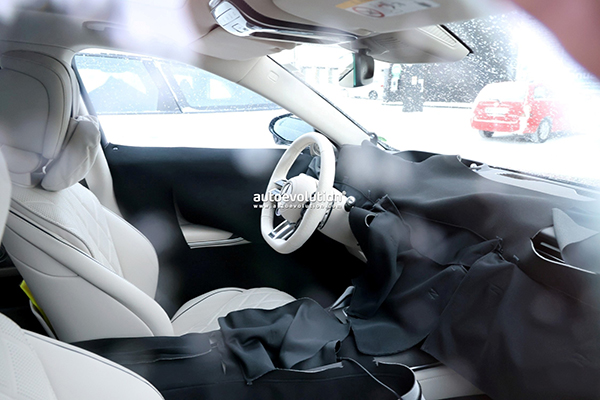
Our spy photographers did manage to snap the dash and front seats. Equipped with brilliant white leather upholstery, the S 63 prototype further shows a redesigned steering wheel that features actual buttons and a scroll wheel instead of touch-only controls. The central vents appear to be located farther to the passenger side, which is another way of saying that Mercedes also worked its magic on the dashboard.
The expansive Hyperscreen is likely to be standard on all facelifted models, and plenty of artificial features from both Google and Microsoft are in the offing as well. With the 2027 model, the S-Class will also introduce the MB.OS operating system. MB.OS will further unlock iDamping, which is the German automaker’s way of saying improved adjustments for the air suspension.
Every S-Class will come with standard rear-wheel steering for 2027. Instead of 4.5 degrees, the S 63 is believed to flaunt 10 degrees by default. As for the most exciting update of them all, the cross-plane crankshaft M177 will be replaced by the flat-plane crankshaft M177 EVO in the S 580.
This lump will supposedly make a bit more in the S 63, though it’s too early to guesstimate. In the facelifted S 580, the revvier engine generates 530 horsepower and 553 pound-feet (750 Newton-meters) of peak torque. Mercedes and the AMG division decided on a flat-plane crank for performance gains and to satisfy the upcoming Euro 7 emission regulations.
Flat-plane cranks are lighter, which means that less work is required to move internal parts due to lower rotational inertia. By generating less internal heat under load, the M177 EVO allowed Mercedes to keep the air-fuel mixture lean and clean in scenarios where the M177 would have had to run a little richer to stay cool.
Evenly spaced exhaust pulses bring the M177 EVO to operating temperature quicker than the old cross-plane design. A cross-plane crank does create backpressure, forcing some exhaust gas back. Those gases make the next combustion dirty, and under Euro 7, such particulate spikes are not acceptable. The flat-plane design, meanwhile, ensures zero pulse interference, resulting in a near-perfect burn with minimal soot.
2026 Mercedes-AMG S 63 Sedan Features New Flat-Plane Crank V8 Engine
29/01/2026
2 Comments
Mercedes-Benz | Mercedes-AMG
Click to rate this post
[Total: 1 Average: 5]

CharlesCEp
I need to tell you something most septic companies won’t: there are two categories of people in this world. Those who think septic systems are simply “subterranean tanks for waste,” and those who have had raw sewage gurgling into their backyard at midnight. I learned this distinction the tough way in 2005—standing in sludge, freezing in a Washington rainstorm, as my brothers and I aided a veteran installer repair our family’s collapsed system. I was a teenager. My hands ached. My pants were ruined. But that moment, something crystallized: This is not just digging. It’s folks’ lives that we’re preserving.
Let me share the harsh truth: the majority of septic companies just service tanks. They’re like band-aid salesmen at a disaster convention. But Septic Solutions? They are different. It all began back in the early 2000s when Art and his siblings—just kids barely tall enough to carry a shovel—assisted install their family’s septic system alongside a experienced pro. Picture this: three kids knee-deep in Pennsylvania clay, learning how soil porosity affects drainage while their peers played Xbox. “We never just dig holes,” Art shared with me last winter, hot coffee cup in hand. “We understood how soil whispers truths. A patch of wetland vegetation here? That’s Mother Nature screaming ‘high water table.'”
https://gitlab.aicrowd.com/-/snippets/97192