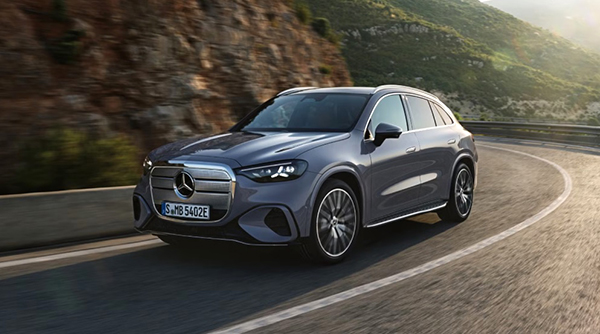
Mercedes-Benz has been publishing fact sheets about the impact of its new models on the market for more than 20 years. Its latest might be the best one yet, though, at least if you’re Al Gore or Greta Thunberg. The latest GLC in electric form cuts two-thirds of its carbon emissions compared with the gas GLC over the entire life cycle of the model. And Mercedes-Benz has the audited details to prove it.
More Recycled Stuff, More Green Power
It’s all about reducing carbon and adding recycled materials. Or secondary materials, as Mercedes-Benz calls them.
The process starts not at the factory, but in the ground. Steel and other ferrous metals are the lion’s share of what goes into every GLC, at 42.3% by weight. Benz says it has worked with suppliers to help them cut carbon, and so it can use lower CO2 steel. That includes using green hydrogen instead of natural gas, renewable energy, and even steel from electric arc furnaces instead of furnaces that use coal or oil.
It cut CO2 from the steel, but the battery and aluminum in the vehicle have had an even bigger impact. Mercedes-Benz says that its cell production footprint produces 40% less CO2. Combined with renewable electricity used at the factory, Benz has pulled out 3.1 metric tons per vehicle just from the pack. Another 1.1 tons comes from aluminum, thanks to more recycled content and green energy.
There are recycled materials in almost all parts of the EV. The tub in the frunk is 50% post-consumer materials. The jacking points are made from recycled bumpers. Even some of the new bumpers are made from old bumpers. The impact here is that 35% of the thermoplastics in the vehicle are reused, not new.
Once the car has reached the end of its life, Mercedes-Benz will recycle the battery. It will focus on second-life, using the cells for grid power storage and similar uses, but it has its own recycling plant for when it comes time. The site can recover more than 90% of the battery pack to be used to make new products, including new cells.
EV Now Nearly Matches ICE In Production Emissions
The result is a 23% cut in CO2 emissions in manufacturing. That cuts its footprint from 19.2 tonnes to 14.8, before the vehicle hits the road.
Once it is on the road, it will use electricity. Mercedes-Benz calculates that as well, based on the EU electricity mix and from a pure hydropower mix. The electricity the SUV will use over its life will, for example, cause 9.3 tons of CO2. On pure hydroelectric power, that would be cut to nearly zero.
On the EU electrical grid, Mercedes-Benz’s lifecycle assessment puts the GLC 400 4Matic EV at 24.5 tonnes of CO2. That includes manufacturing, charging, and the end-of-life process. Clean electricity would drop that to 15.3. For comparison, the Mercedes-Benz GLK produced 8.1 tons from manufacturing but a total of 67.2 over its lifetime.
The modern model, even as an electric, causes only a small amount more carbon than the older vehicle just in manufacturing. Over its lifetime, the gap becomes massive in favor of the EV. Benz calls it a holistic approach, and it seems to be paying dividends.
2026 Mercedes-Benz GLC Does Something The Old One Could Only Dream Of
28/03/2026
No Comments
Mercedes-Benz | Mercedes-AMG
Click to rate this post
[Total: 1 Average: 5]
